
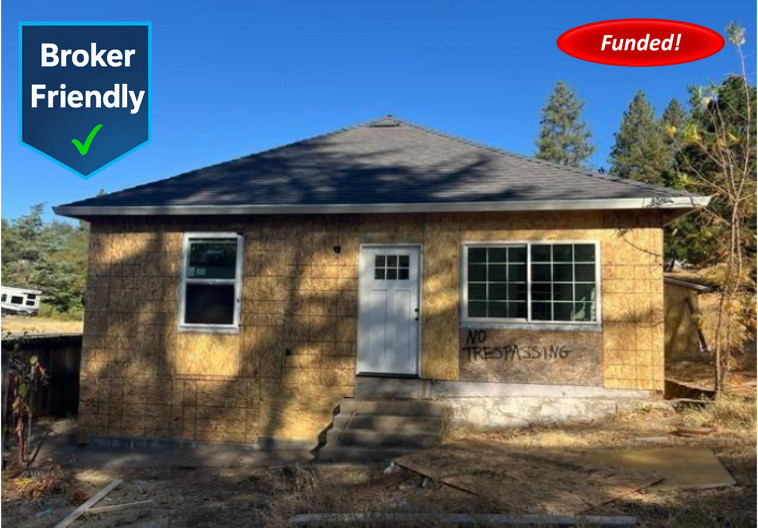
Mortgage Vintage funded a $250,000 first trust deed construction rehab loan secured by a non-owner occupied single-family residence in Placerville, CA. The business-purpose loan provided a cash-out rehab facility to a repeat borrower with demonstrated fix-and-flip experience, enabling completion of a finishing rehab on a historic single-family home in El Dorado County. This Placerville rehab loan was structured with an 18-month term, a $190,000 construction holdback managed through funds control, and a clear DSCR refinance exit strategy upon project completion.
Why This Placerville Rehab Loan Stood Out
- First lien position with a conservative 58.82% LTV and a 10.44% net LTV, both calculated using the lower of two independent after-completion values of $425,000, providing strong collateral protection for investors.
- The borrower had already invested approximately $90,000 of personal capital into the project prior to closing, covering foundational work including foundation, framing, electrical, roofing, and plumbing, demonstrating meaningful skin in the game.
- The $190,000 construction budget was independently reviewed by a third-party construction feasibility provider and confirmed to be sufficient to complete the scope of work and obtain a Certificate of Occupancy.
- All construction disbursements were subject to a structured funds control process with third-party inspections at each draw stage, reducing completion and disbursement risk.
- The loan carried six months of guaranteed interest and six months of prepaid interest, providing investors with income certainty from day one.
- Investors could access this trust deed opportunity through the CrowdTrustDeed platform, with a minimum investment of $50,000.
- The borrower was a repeat Mortgage Vintage client with a track record of successfully completing investment property projects, and the credit file showed no reported late payments.
Property Description
The subject property was a single-story, detached single-family residence located in Placerville, El Dorado County, California, originally constructed in 1900. The home contained approximately 928 square feet of living space, configured as two bedrooms, two bathrooms, and four total rooms, situated on a lot of approximately 10,450 square feet. Exterior construction featured stucco walls, and the home included central air conditioning, forced-air heating, a porch, and partial fencing. The property was well positioned near El Dorado High School, with convenient access to local restaurants and shops. Upon completion of rehabilitation, the property was projected to generate approximately $2,200 per month in rental income, supporting the borrower’s long-term hold-and-rent investment strategy.
Investment Summary
Mortgage Vintage originated this business-purpose cash-out construction loan as a first trust deed at an 11.00% annual investor rate. The $250,000 loan represented a 58.82% loan-to-value ratio and a 10.44% net LTV based on the conservatively selected after-completion value of $425,000. The $190,000 construction holdback was managed through a formal funds control arrangement, with each draw tied to verified progress inspections by an independent third party. An independent construction feasibility review had confirmed that the budgeted amount was adequate to complete all remaining work and secure the Certificate of Occupancy. The borrower’s planned exit was a refinance into a DSCR loan upon completion, using the stabilized rental income to qualify for permanent financing and repay the construction bridge loan. The offering featured an 18-month term, six months of guaranteed interest, and six months of prepaid interest, with a minimum investment of $50,000.
Financial Details
| Field | Value |
|---|---|
| Loan Amount | $250,000 |
| Lien Position | 1st Trust Deed |
| Interest Rate | 11.00% Annual |
| Loan Type | Construction / Cash-Out Rehab |
| Loan Term | 18 Months |
| Guaranteed Interest | 6 Months |
| Prepaid Interest | 6 Months |
| LTV (After-Completion Value) | 58.82% |
| Net LTV | 10.44% |
| After-Completion Value Used | $425,000 |
| Construction Holdback | $190,000 (Funds Control) |
| Minimum Investment | $50,000 |
| Occupancy | Non-Owner Occupied |
| Exit Strategy | DSCR Refinance Upon Completion |
Property Highlights
| Field | Value |
|---|---|
| Property Type | Single-Family Residence (SFR) |
| Location | Placerville, El Dorado County, CA |
| Year Built | 1900 (Original Construction) |
| Living Area | Approx. 928 Sq. Ft. |
| Bedrooms / Bathrooms | 2 Bed / 2 Bath |
| Total Rooms | 4 |
| Lot Size | Approx. 10,450 Sq. Ft. |
| Stories | Single-Story |
| Exterior | Stucco |
| Heating / Cooling | Forced-Air Heat / Central A/C |
| Projected Rental Income | Approx. $2,200/Month |
| After-Completion Value (Used) | $425,000 |
| Independent ARV (High) | $445,000 |
Frequently Asked Questions
What is a construction holdback and how does funds control protect trust deed investors?
A construction holdback is the portion of a rehab loan that is not released to the borrower at closing but instead held in reserve and disbursed incrementally as construction milestones are completed. Funds control is a third-party management process in which an independent administrator receives, holds, and releases those funds only after verifying that completed work justifies each draw request. For trust deed investors, this structure significantly reduces the risk that loan proceeds will be misapplied or that the project will stall mid-construction, since payments to contractors are tied directly to verified progress inspections rather than released in a lump sum.
Why do hard money construction lenders use the lower of two appraisals when calculating LTV on a rehab loan?
When a property is undergoing substantial rehabilitation, lenders often commission multiple independent value opinions to establish the most defensible after-completion value. Using the lower of those values to calculate the loan-to-value ratio is a conservative underwriting practice that protects both the lender and trust deed investors. If market conditions shift or the project takes longer than anticipated, the additional value cushion created by using the more conservative figure provides a greater margin of safety in the event of default or the need to liquidate the collateral. In this transaction, Mortgage Vintage used the $425,000 after-completion value rather than the higher $445,000 estimate, resulting in a 58.82% LTV.
What is a DSCR loan and why is it a common exit strategy for fix-and-hold investors using hard money construction financing?
A Debt Service Coverage Ratio, or DSCR, loan is a type of investment property mortgage that qualifies the borrower based on the rental income the property generates rather than the borrower’s personal income. Once a rehabilitation project is complete and the property is stabilized as a rental, an investor can refinance out of the short-term hard money construction loan and into a longer-term DSCR product. This exit strategy is particularly well suited for fix-and-hold investors because it allows them to retain ownership of the asset while replacing higher-rate bridge financing with more permanent, lower-cost debt. The rental income supports the new loan’s debt service, and the proceeds from the DSCR refinance repay the original construction lender.
Mortgage Vintage, Inc. is a California DRE-licensed hard money lender and trust deed investment company with deep expertise in originating, underwriting, and servicing business-purpose real estate loans secured by California real property. With a track record spanning hundreds of funded transactions across diverse property types and loan structures, Mortgage Vintage brings the hands-on experience and regulatory compliance that investors and borrowers in the trust deed market depend on.